
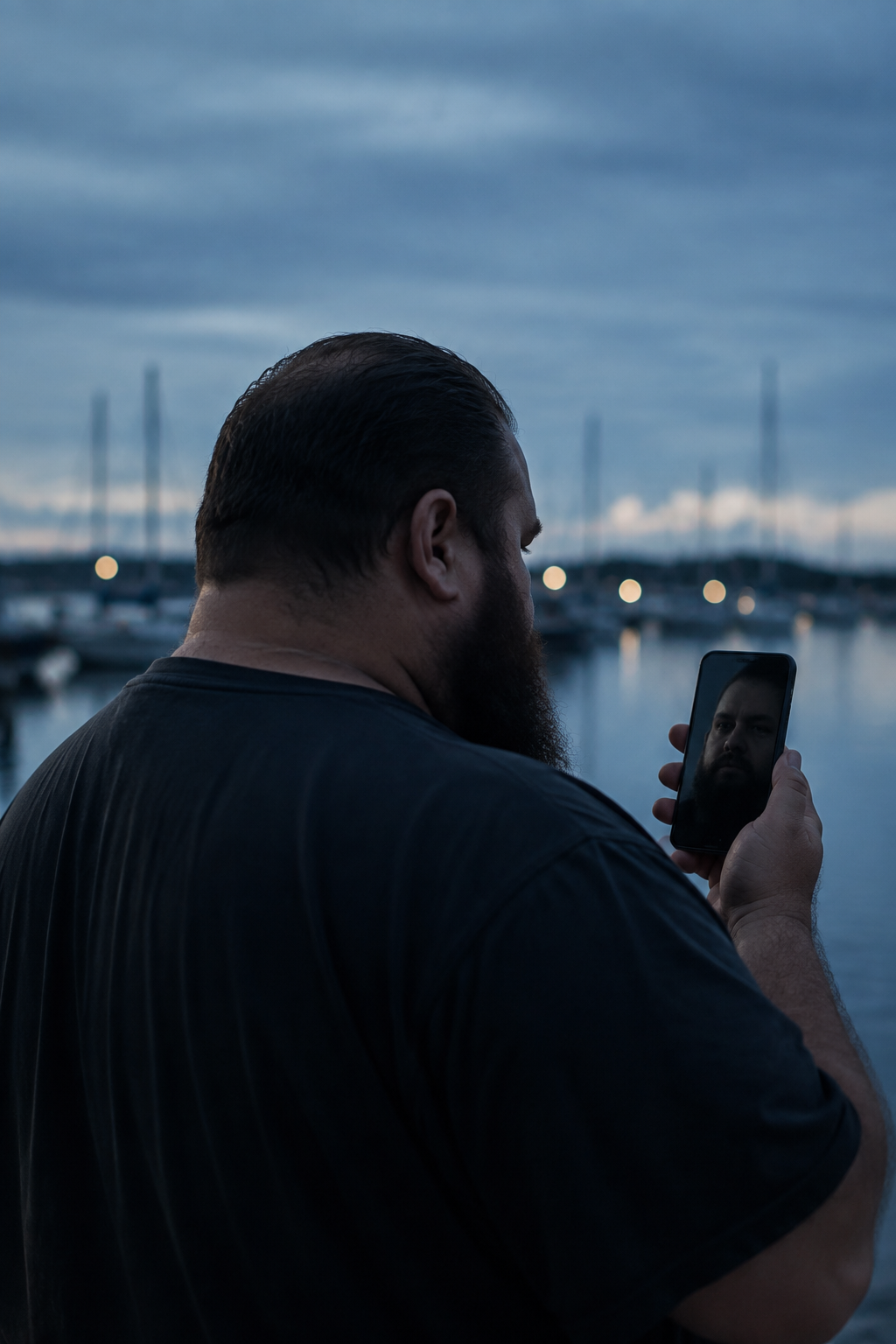
I met Marco on Facebook.
Huge build. Beard. Tight T-shirt. Gym, cars, marinas. Rome. One hundred and thirty-five kilos. Rugby player.
After a few photographs I had already started to recognise him.
Not to know him.
To recognise him.
Then I reached his Fanvue page. The bio said quite clearly:
AI generated.
Marco does not exist.
No one woke up that morning, put on a black T-shirt and went down to the marina. No photographer asked him to turn towards the light.
Someone asked a machine to do it.
That could be the end of it.
A curiosity of artificial intelligence. A convincing face. A well-built body.
But Marco has followers.
He has locked content.
And to see it, you have to pay.
That is where the story changes.
Why does someone create a person who does not exist?
The simplest answer is: money.
A virtual creator does not get tired, change his mind or turn up late. He can be in Rome in the morning, at the gym in the afternoon, on a boat in the evening.
He can remain the same for years.
He can be exactly what someone wants him to be.
And perhaps that is the most interesting part.
Creating Marco also means creating someone’s ideal man.
The right body. The right beard. The right way of dressing.
A person without complications.
But the question that interests me most is another one.
Why pay?
Why spend money to see more photographs of a person you know does not exist?
It sounds absurd.
Then you think about it.
We have always paid to feel something in front of things that do not exist.
Films. Novels. Characters.
We cry for people who were never born.
We fall for actors playing somebody else.
So perhaps fiction is not the problem.
It is that with Marco, fiction has acquired a face.
And that face looks back at you.
After a while, you recognise him.
You know he does not exist, but you recognise him anyway.
Perhaps whoever pays is not buying a photograph.
They are buying a precise fantasy.
A type of man.
A type of body.
A type of presence.
Someone who is there whenever you want to look, and absent whenever you do not.
Marco does not disappear.
He does not reply three days later.
He does not say he is not looking for anything serious.
He has no ex.
He is not afraid of intimacy.
He is not complicated.
He is not real.
And perhaps that is exactly the point.
Because real people have one terrible flaw.
They are real.
They change.
They disappoint.
They have desires that do not coincide with ours.
Marco does not.
Marco can always be what someone expects him to be.
Of course, behind Marco there is a real person who creates him, manages him and decides what to publish.
So the human being has not disappeared.
He has simply moved backstage.
What remains in front is the character.
And while I looked at those photographs, I had a strange feeling.
Not because they were false.
But because after a few minutes, the fact that they were false seemed less important.
If a person has never existed but can still provoke desire, curiosity or affection, how false is the emotion they create?
Perhaps we will not pay because we believe Marco exists.
Perhaps we will pay precisely because he exists just enough.
Continue the thought
What are we really paying for: an image, a fantasy or a presence without risk?